Food Security in a Time of Change

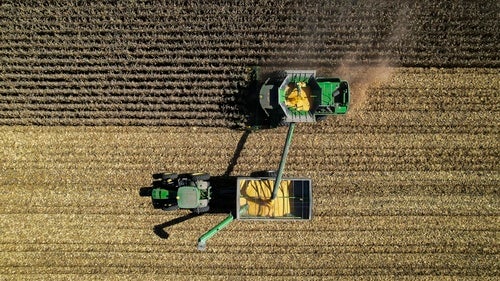
Geopolitical developments are having disruptive impacts on Midwestern agriculture.
It is arguable that the Midwest region of the United States is among the most comprehensive centers for agricultural production in the world. In addition to its extremely well-developed soils and favorable climate for rain-feed farming, it is home to major firms that produce state-of-the-art machinery for global markets, serves as a center for modern marketing and financial firms, and offers a multicomponent logistics system. It also has a well-trained workforce and world-class universities, which have great capacity for student education as well as cutting-edge discovery and translational science.
The Midwest of today is the product of nature, as well as the efforts of visionary leaders who made bold decisions during the American Industrial Revolution. Coal and iron ore, key elements in large-scale manufacturing, were in abundance in the Midwest. The industrial growth of the 1800s required a large workforce living in proximity to factories, as well as engineers capable of designing the factories, what these factories would produce, and the logistical systems that would enable access to the required inputs and distribution of the manufactured goods to domestic and international users. The growing complexity of business, finance, and marketing further revealed the need for skilled professionals to work in these areas.
It also became apparent that there was a need to produce more food with greater efficiency. The Yale Report of 1828 first raised the question of whether traditional universities should play a role. But it was the Morrill Act of 1862 that gave federal support to one university in each state “for the benefit of agriculture and the mechanic arts,” creating capacity to meet the need. Through research, campus instruction, and public education, these so-called land-grant universities dramatically increased the productivity of US agriculture.
To a significant extent, the incredible advances made during the Green Revolution between 1950 and 1970 were the product of transmitted knowledge from US land-grant universities and the long-term engagement of those institutions in establishing similar food and agricultural universities in developing countries.
Restricted Production
Sadly, famine continues to occur due to a myriad of factors, including poverty, conflict, inadequate governance, lack of access to improved seed varieties, depleted soil fertility, dated agronomic practices, poor logistical systems, and losses in harvest and storage.
It can be said that the Green Revolution focused on producing just enough to feed the local village (a problem that remains in some areas of the world). It made sense at the time. In 1950, only two global cities had a population greater than 10 million. But 75 years later, that number had grown to 33, according to the United Nations. And where food needs were once supported by the variety of crops grown in a local region, production has become specialized, and individual crops tend to be concentrated in regions where soil and climate conditions are more favorable.
There are obvious challenges to restricting production to regions especially suited for a particular crop. For such an approach to be successful, there must be a highly functional logistical system capable of moving large quantities of food great distances. In recent years, more than 30 percent of fresh vegetables and nearly 60 percent of fresh fruit consumed in the United States were imported, much of it from Mexico and Canada.
The costs associated with transportation are obviously vulnerable to increased fuel prices and other factors. Of greater concern is the potential for destruction of vital infrastructure, such as major bridges, by bad actors—domestic or international. One can only speculate on the impact that a significant loss of infrastructure would have on the availability of food in major urban centers in the United States or elsewhere.
Such an approach also means that crop failure in one or more regions can cause upheaval in distant parts of the world. Ten countries produce more than half of the world’s wheat. In 2007 and 2008, depressed production due to drought dramatically increased the price of food in countries heavily reliant on wheat. And studies have shown that the subsequent economic shock was a major driver of political upheavals in several countries.
In less developed countries, transport of foodstuffs to population centers often suffers from a lack of infrastructure, with the effect compounded in rural regions by a lack of access to critical production inputs, such as equipment, fuel, seed, and fertilizer. Addressing infrastructure needs would improve the delivery of food, and the sale in urban centers would enable economic development at the village level.
Predicting the Future
At the time of the Green Revolution, there remained a significant amount of undeveloped arable farmland. That is no longer the case. Of growing concern today is the loss of the planet’s productive land to urbanization, modern warfare, soil contamination, wind and water erosion, long-term overgrazing, and soil loss.
Since World War II, the movement of foodstuffs for humans and animals has been facilitated by trade policies that have not been especially restrictive. But that is changing with the regional specialization of production, making it increasingly possible for food access to become a means of geopolitical coercion. Such concern is not limited to food. Highly productive agriculture requires critical inputs such as fuel, fertilizer, technology, and information that originates in different nations, all of which can be disrupted by conflict and trade barriers. While fuel is obvious, many are unaware of the regionalization of plant nutrients. For example, 90 percent of potash, a primary source of the plant nutrient potassium, is imported.
Geopolitical developments have disruptive impacts on Midwestern agriculture. The region is a major production center for corn, soybeans, wheat, pork, and beef, and is thus reliant on international markets.The region is also the global headquarters for companies that produce and deliver agricultural and food technologies around the world.
It is said that “predicting the future is a difficult science,” and that is certainly true. The Midwestern food and agricultural sector may be facing a paradigm change. And it is clear that future economic success will depend on us understanding and adapting to the multitude of forces driving the change. The natural advantages and human creativity that served the region so well in the past remain. The challenge is for leaders to not only provoke the conversation but also serve a significant role in spurring solutions.
Universities have historically enjoyed a significant role in driving change. However, the need comes at a time when leading universities are dealing with major challenges posed by artificial intelligence and curricular changes required for graduates to find success in their careers and serve in the advancement of society. In a sense, it is similar to the challenge faced by these institutions in the 1800s, when they were expected to produce agriculturalists and engineers who would meet the needs of the Industrial Revolution.
Fundamental research into the physical and biological phenomena that underlie life is likely to be enhanced by artificial intelligence. It is the application of such new understandings where challenges might be anticipated. That work will require an understanding of the food and agricultural system and judgement that may be less amiable to the use artificial intelligence, as such judgement comes in part from life experience and an understanding of the needs of those currently dependent on agriculture.
Success in providing adequate food for the people of the world regardless of circumstance will come only if there is committed, pragmatic leadership in government, agribusiness, and on the farms. But the most critical element may simply be an awareness of the challenges that lie ahead. This is a role that an organization such as the Chicago Council on Global Affairs can fill.
The Chicago Council on Global Affairs is an independent, nonpartisan organization and does not take institutional positions. The views and opinions expressed in this commentary are solely those of the author.