AI Chatbots Are Giving Farmers New Choices

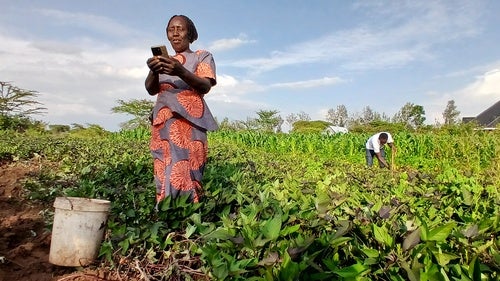
A quiet revolution is happening on small farms in Africa and Asia as farmers access better information via AI-powered apps.
A quarter of the global population relies on the world’s roughly 570 million farms for their livelihoods. Income and food access are precarious for these 2 billion people, whipped constantly by markets, weather, and policy shocks. In 2026 alone, fertilizer prices rose by 30 percent due to the closure of the Strait of Hormuz, and farmers could face more price pressure in the coming months.
The World Food Programme (WFP) predicted in March that a continuation of the Middle East conflict through 2026 could push 45 million more people into acute hunger. Now, the worst El Niño weather pattern in 150 years is approaching, which could bring droughts and floods, as well as increased pest and disease pressure for crops and livestock. Governments and the United Nations are trying to take preventative action to support the 8.8 million in severe food security risk zones in 22 countries but such responses are difficult to pull off, especially in low-income countries. Early measures often fail to materialize due to a lack of funding, poor channels for disseminating information, and challenges with prepositioning physical goods.
A better way of addressing these worsening issues has been needed for some time. Now, thankfully, there is a new way to harness humanity’s collective intelligence about producing food and share it with farmers: novel artificial intelligence (AI) tools.
The Emergence of Generative AI
Governments have long tried to keep farmers afloat and citizens fed through price supports, farmer organizations, and shared market and storage infrastructure. Over the last 200 years, farmer education services have emerged in several countries to combat pest outbreaks and channel scientific breakthroughs to producers, including the Cooperative Extension System (CES) in the United States. Still, getting the right information to farmers at the right time has remained an operational uphill battle.
Many smallholder farmers cultivate 10 to 12 different crops in addition to raising livestock. How does one person reach hundreds if not thousands of these farmers with the right information at the right time? Hiring more trained experts could ease the burden, but it is not a reasonable solution; the costs for governments to maintain such a front line would be high, and there is little budget available. As such, coverage has generally remained limited to a small percentage of farmers in most countries.
Other approaches have been tried over the last 70 years, including replicating the US land-grant model in other countries, refining the United Nations Food and Agriculture Organization’s (FAO) farmer field schools, investing in farmer-led research models, and, for the last decade, experimenting with digitally delivered advice. Evaluations of extension services have often shown there to be little to no impact. And while digital tools resulted in some gains, they have been unable to keep up with the complexity of farming. As such, these agricultural technology tools have often been rightfully abandoned by farmers who simply didn’t find them useful enough to maintain.
The emergence of generative AI has changed what felt like a deadlocked innovation landscape for agriculture. There is now a visible path to a future in which every farming household on earth has access to timely, high-quality information and advice when they need it most. Within the next 10 years, farmers could have a much better shot at achieving resilience and a dignified life in uncertain climatic times.
A New Era of Possibility
The international nonprofit Digital Green, where I serve as chief strategy officer, has been at the forefront of pushing technology as a potential tool for advancing food security for 20 years. The same question that sparked our founding still animates our work today: What can digital technology do for small-scale farmers?
In 2010, we found a simple but elegant solution: short explainer videos created by and for farmers. The videos dramatically reduced the cost of delivering an advisory by a factor of 10 and increased the incomes of farmers by 24 percent over two years. But technology and farming have continued to evolve. To keep pace, we launched an AI-supported chatbot called “FarmerChat” in 2022. It is a simple tool, enabling farmers to ask questions via text, voice, and photos, with responses available in more than 10 languages. Today, more than 2.5 million farmers have installed the application, and upward of 12 million answers covering most crops and livestock have been provided to questions raised in Kenya, India, Nigeria, Ethiopia, Zimbabwe, and beyond.
The feedback is extremely promising. Fifty-four percent of FarmerChat users reported time savings, and 57 percent reported improvements in their quality of life after just 45 days of use. There has also been a higher rate of adoption than with the explainer videos. According to internal surveys and externally validated studies, 60 to 80 percent of active users reported changes to their farming practices within 30 to 60 days. And with the advent of digital onboarding via social media and other channels, a single user can be onboarded and served for a year for under $1.
We are in a new era of possibility. As mobile data and smartphone penetration improves and we learn how to responsibly and inclusively shape AI tools for farmers, we will see an end to the classic information asymmetry. And that will change the world.
Just by equalizing access to knowledge, we may see part of the productivity gap between high-income farmers and low-income farmers drop by 10 to 30 percent, if not more. This kind of collective jump in productivity, seen with the introduction of hybrid maize in India in the 1960s and with the introduction of new varieties and fertilizers, has historically been accompanied by a steep reduction in prices, the creation of new institutions or policies, and, in some cases, a movement of farmers into other opportunities.
Today’s technology is transforming the nature of the economy and employment not only around but within agriculture. This means the benefits will be broad and sectoral rather than concentrated on commodities and efficiency. And in Africa, the technological leap is happening at a time when the youth dividend is coming into its own.
Bending the Arc
In an optimistic scenario, it’s possible to imagine the broad-based impact of AI supporting a more biodiverse, locally adapted production system.
The sheer shortage of frontline workers has meant advice has clustered around the most important crops and livestock, preventing investment in those that might better thrive and generate profit for specific farms. With AI tools, farmers would be able to ask about any crop or livestock they wanted. This could help make small and medium farms competitive against their larger peers, and more resilient. For Africa, where a rapidly growing youth population intersects with large agricultural employment, this scenario could enable a generation of farmers and rural entrepreneurs to build viable livelihoods and novel service-based businesses around these emergent, more biodiverse farming systems.
The pessimistic view, however, is that AI may simply accelerate familiar dynamics in a new form. If advisory systems are only optimized for the most commercially valuable crops, the creation of advisory content is controlled by too few, and the content is used to drive sales for the products alone, the benefits could be concentrated to a narrow sets of commodities and the farmers who excel in them. In that case, the technology would entrench existing systems, deepen existing information asymmetries, and undermine public and traditional farmer knowledge systems, rather than broaden opportunity and choice.
Bending the arc toward the optimistic scenario will take intentional participation, transparency, and accountability for those leading in the development of AI for agriculture. And there’s a role for nearly everyone in building and shaping this powerful tool.
- Farmers should be put at the center of agricultural research, AI, and policy. One of the amazing things about FarmerChat, is the ability to see what a variety of farmers are actually interested in solving for at scale. Consistent farmer usage has produced data exhaust at a more dynamic and larger scale than prior census or survey data could gather. Benchmarking answers to questions against farmer-centered experts like CES agents, we can see where the quality of the advisory falls short and are able to improve performance with a high degree of localization. As researchers are better able to surface farmer adaptations, it will further change the focus of agricultural science, product development, and policy in a way that better supports farmers.
- Private agriculture companies should make their product details easily discoverable. One challenge we have encountered with FarmerChat, is that local brands often have very similar sounding names for their seeds, (bio)pesticides, and fertilizers but have distinct chemical makeups and manufacturers. Private companies could establish product catalogues mapped to geographies and make them Application Programming Interface (API) accessible, which would allow them to be easily accessed by new AI protocols like Anthropic’s Model Context Protocol (MCP). This would instantly improve the accuracy of what farmers know about their products and how to safely use them—not just on FarmerChat, but across digital tools. The same goes for insurance and agricultural financial companies.
- Governments should benchmark AI tools and make high-priority information easier to amplify across AI-enabled channels. The benchmarking of AI technologies for agricultural advisory is in its infancy. With time, governments should develop standards to evaluate models and tools against their own established standards. As that develops, they should also make early weather, pest, and disease warnings and information about farmer support programs and subsidies easier to discover by publishing information access points, just like in the private sector.
- Telecommunications companies and satellite internet providers have huge contributions to make. Digital Green has already seen that when farmers can access our tools without needing to pay for mobile data, they ask 33 percent more questions. Some mobile data companies will make applications like ours ‘zero rate’ to help new digital users see the benefit. If this can be done uniformly, more farmers will gain access.
- Philanthropy and official development assistance will make a difference. New entrants to philanthropy, including those connected to prominent AI companies, have a lot to contribute. As a sector, we’re still learning how to most efficiently incorporate local knowledge while ensuring affordability and accuracy. Many languages are not supported yet and need more investment, and agrivernacular is weak even in offered languages. Weather models are also still too inaccurate and lack interpretability for farmers (What does a 60 percent chance mean?). Testing, experimenting, and codesigning with farmers across geographies costs money. Philanthropy and forward-looking development assistance should see this as one of the greatest opportunities there is to realize the benefits of AI for humanity.
Today, AI conversational advisors are receiving tens of millions of questions from farmers around the world, revealing their needs, insights, challenges, and priorities. This technology is a new expression of our collective intelligence. And it belongs to the world’s farmers, too. If we help bend technology to their needs, we will be able to see what they can do for all of us as the consumer-beneficiaries of their work.
The Chicago Council on Global Affairs is an independent, nonpartisan organization and does not take institutional positions. The views and opinions expressed in this commentary are solely those of the author.