Can COP31 Deliver on Climate Finance?

Regional conflicts, a sidelined US administration, and a rising China are complicating global action on climate change.
It’s been a tough couple of years for global climate cooperation. US President Donald Trump withdrew the United States from the 2015 Paris Agreement (again) and signaled in January of this year an intent to withdraw from the broader 1992 United Nations Framework Convention on Climate Change (UNFCCC). International efforts to implement and deepen these climate change agreements have struggled amid renewed geopolitical rivalry and resource demands.
Meanwhile, global temperatures have continued to rise. The aspirational goal of limiting global temperature increases to 1.5 degrees Celsius above preindustrial levels is now out of reach, with the threshold likely to be eclipsed on a permanent basis in the next few years—much earlier than anticipated. Manifestations of a warming planet are all around us, from glacier floods in Nepal to wildfires across Europe.
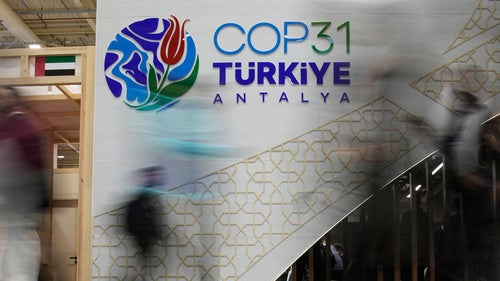
It is under these circumstances that some 60,000 diplomats, community leaders, business executives, researchers, and journalists are meeting for the 31 st United Nations Climate Change Conference, or Conference of the Parties (COP), in Antalya, Turkey.
COP31 has an unusual structure. Turkey is hosting but the negotiations are being led by Australia, as both countries wanted to get in on the action: Turkey to showcase its long-term climate ambitions and Australia to highlight regional vulnerabilities of Pacific Island countries.
It remains to be seen whether there will be (m)any advances at the summit. Most of the architecture of the Paris Agreement has already been negotiated. And because we are now in the business end of implementation, it’s not clear there is a lot to be delivered through these meetings—though an effort to encourage countries to electrify more of their economy (35 percent by 2035) might be one breakthrough target.
Countries have also already submitted the third round of Nationally Determined Contributions (NDCs), so-called pledges of what climate actions they intend to take in the next five years. Last year was the year updated NDCs were supposed to be made, though the wider political environment meant that most countries that submitted plans displayed limited ambition.
Still, as in previous COPs, there will be significant clamors for new resources to support developing countries with funds for clean energy transitions, adaptation to climate and impacts, and “loss and damage” compensation.
Debt Relief and Climate Finance
With the United States on the sidelines and other governments facing significant challenges in mobilizing foreign assistance, this meeting may not be ripe for big breakthroughs on finance. Still, there is an opportunity to tie climate finance to a renewed push for debt relief. Climate campaigners have not made that a big call to action yet, but they should.
Twenty-six years ago, an international coalition successfully mobilized under Jubilee 2000 campaigned for international financial institutions and wealthy nations to relieve the debts of the world’s poorest countries so they could spend more on education, public health, and other key investments. Ultimately, more than $100 billion in debt was canceled through the Heavily Indebted Poor Countries (HIPC) and Multilateral Debt Relief Initiative (MDRI) frameworks.
Now, developing countries, particularly in sub-Saharan Africa, are experiencing a new debt crisis, in which they are diverting essential funds for development needs to pay off old loans plus interest to foreign creditors. External debts of developing countries now total some $9.4 trillion. Though domestic mismanagement is partly to blame in some cases, there are other external drivers, including lost years during the COVID-19 pandemic; rising costs of food, fuel, and fertilizers amid the Ukraine and Iran wars; and the higher burden of climate impacts. Poorer countries also tend to face higher borrowing costs than wealthy countries.
What’s different today is that China has emerged as a major lender, complicating multilateral debt relief efforts. While expanding other climate finance commitments might thus be tricky, debt for nature swaps have long been around, offering some debt relief in exchange for committing freed-up resources to conservation projects. New debt-for-climate loan forgiveness might free countries up to make further key investments in resilience and clean energy, with initiatives that include China likely proving more successful.
At COP27 in 2022, parties agreed to create theFund for responding to Loss and Damage (FRLD) to assist developing countries affected by climate impacts. About $822 million has been pledged to the fund and $450 million paid in, with requests from developing countries totaling more than $2.8 billion and one estimate putting developing countries' needs at $400 billion a year. The fund has been slow to capitalize fully and pay out, with petitioning countries often getting a small percentage of what is needed. Following the August 26 flood that killed nearly 1,500 people, Nepal was awarded a mere $20 million by the fund—less than 1 percent of what it will need to cover the damages. There will likely be some pressure at COP 31 for donors to meet their pledges and an insistence that the funds be distributed more quickly.
At COP29, the international community agreed to scale up its commitment to mobilize $300 billion a year in climate finance by 2035 under the New Collective Quantified Goal on Climate Finance (NCQG), increasing the previous commitment of $100 billion a year. Those pledges include both public and private money and are distributed as bilateral aid through a variety of channels, including multilateral initiatives like the Green Climate Fund and through private actors. With about $140 billion mobilized in 2024, we can expect some pressure from developing countries for donors to speed up their contributions and distribute more of them as grants, rather than loans.
Slow Progress but Some Opportunities
Progress on climate change has been slow, with many false starts and setbacks. Efforts though have helped blunt the expected warming, which was once thought likely to increase more than 4 degrees Celsius above preindustrial levels by the end of the 21 st century. Because of technological change and efforts at previous COPs, we are now on track for a rise of 2.8 degrees Celsius, which is still hugely worrisome but a significant improvement.
More recently, China’s immense overcapacity in manufacturing has led to declining costs of clean technologies, including solar panels, batteries, and electric vehicles. We are now seeing rapid adoption of these technologies from Pakistan to Cuba, making the prospect of a clean energy transition more attractive and feasible. And while China’s industrial capacity poses real problems for developed countries’ manufacturing industries, it has been a boon for developing countries trying to navigate fuel disruptions and high prices in the wake of the Iran war.
China’s own climate trajectory is uncertain, especially given its immense coal reserves and its responsibility for more than 30 percent of global emissions. Yet, with massive installations of renewables, recent reports suggest China’s emissions fell by 3.1 percent in the third quarter of 2026 after a wider two-year plateau in emissions. Thus, in some respects (and despite the lack of progress in global negotiations), we could be poised for greater decarbonization in the years to come.
Looking Back and Looking Ahead
Last year, Trump’s moves against climate action and global coordination cast a pall over the proceedings. The international community put on a brave face and soldiered on with the negotiations, held in the Amazonian town of Belém, Brazil, where perhaps the most significant achievementwas the launch of a new financing model for rainforest conservation known as the Tropical Forests Forever Facility (TFFF). The global trust fund has been a modest success, with nearly $8 billion pledged as of October.
While there was a conversation about an explicit commitment to phasing out fossil fuels, the largely consensus-based meetings with fossil fuel producers in attendance made it impossible to reach an agreement. However, in May, a conference in Santa Marta, Colombia, attracted nearly 60 first movers who were most interested in making a more explicit commitment to fossil fuel phaseout. This was intended to be the first of a longer-running process, with a second meeting already planned.
It was not the first time a “coalition of the willing” has come together. Since COP23 in 2017, the Powering Past Coal Alliance has been championing a coal phaseout through a network of national and subnational governments and other partners. And at COP26 in 2021, more than 100 countries joined the United States and European Union in pledging to reduce methane emissions.
To be more broadly successful, however, climate negotiations require favorable circumstances, with leaders in power who are committed to taking action to address the problem. In 2015, that was true for both the United States and China. But save for a brief respite during the Biden administration, the United States has been on the sidelines or worse in the climate arena since 2016.
This year’s meeting in Antalya may thus not yield much. Still, President Luiz Inácio Lula da Silva’s reelection in Brazil and the Democratic Party’s sweep in the 2026 US midterm elections suggest the politics may again become more favorable—at least to parts of the climate agenda. This may make future COPs more important, though the real action is what is happening on clean energy and resilience in countries around the world.
The Chicago Council on Global Affairs is an independent, nonpartisan organization and does not take institutional positions. The views and opinions expressed in this commentary are solely those of the author.